
Odds are your credit union already relies on at least one CUSO. Maybe several. You just might not call them that.
Shared branching, your loan-origination platform, the investment-services desk in your lobby, the company that runs your core: a surprising share of what keeps a credit union running comes from a CUSO. Four letters that show up in board packets and vendor contracts, usually with no one stopping to explain them.
So let's explain them.
What is a CUSO (credit union service organization)?
Start with the question everyone actually asks. What makes a CUSO a CUSO? What sets it apart from any other company selling to your credit union?
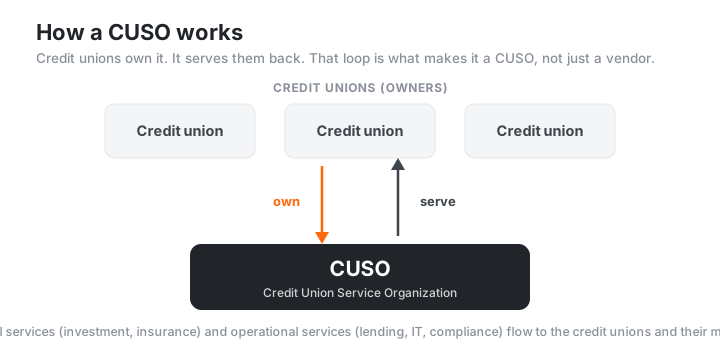
Ownership. CUSO stands for Credit Union Service Organization. It's a company that credit unions own, in whole or in part, and that exists mainly to provide products and services to credit unions and their members.
That ownership is the whole point. A CUSO isn't just any firm selling to the movement. NCUA defines it as an entity a federally insured credit union has an ownership stake in (or has lent money to) that primarily serves credit unions or their members. Own a slice of it, and it's a CUSO. That's the line that separates a CUSO from an ordinary vendor.
A CUSO takes the form of a corporation, an LLC, or a limited partnership. Most are LLCs. One credit union can own the whole thing, or dozens can share it, sometimes alongside trade groups, individuals, or even other CUSOs. The structure flexes. The purpose doesn't: serve credit unions.
What CUSOs do
CUSO work splits into two buckets.
Financial services put a product in front of your members that you'd struggle to offer alone: investment and insurance services, brokerage, wealth advice. The member sees your brand at the desk. A CUSO runs the engine behind it.
Operational services are the back-office muscle: loan origination and servicing, IT and cybersecurity, compliance support, call centers, and consulting on the balance sheet and interest-rate risk. Work that takes scale or specialized talent, done once and shared across many credit unions.
The thread through both is collaboration. A $200 million credit union can't staff a wealth-management arm or build a lending platform from scratch. Ten of them, pooled into a CUSO, can. That's the move: share the cost, share the expertise, keep the member relationship.
The rules: what NCUA allows
Here's where you want the facts exact, because this is regulated ground.
For a federal credit union, NCUA's Part 712 sets the limits. Part 712 caps your total investment in CUSOs at 1% of your paid-in and unimpaired capital and surplus, measured as of last calendar year-end, and caps your total loans to CUSOs at a separate 1% of that same base. The loan authority stands independent of the investment authority, so the two don't share a bucket. Fall below adequately capitalized and you can't stretch past those limits without prior written approval from your NCUA regional office. (State-chartered credit unions follow their own state's rules, with NCUA's Part 741 governing the insurance side.)
Two more rules worth knowing. A federal credit union may only invest in a CUSO that primarily serves credit unions and their members, a test NCUA weighs on the totality of the circumstances, not a single number. And every CUSO files financial information with NCUA through the online CUSO Registry and reaffirms it each year. Close to 900 CUSOs sit in that registry today, and anyone can search it by name, state, or the services offered.
Why credit unions use them
Strip away the acronym and a CUSO is just credit unions doing what they've always done: cooperating. Not-for-profit institutions can't raise outside equity the way a bank can, so they can't always buy their way into scale. They build it together instead.
A CUSO lets a small shop offer big-shop services without the big-shop overhead. It turns a fixed cost you'd carry alone into a shared one. And done right, it keeps profit and control inside the movement rather than handing both to an outside firm. That's the case for a CUSO in one breath: reach you couldn't afford, on terms you help set.
This article is educational only. It is not legal, financial, or regulatory advice. For the governing rules, rely on NCUA's Part 712 and your own counsel, and confirm current limits before you act.
Not every partner your credit union works with is a CUSO, and not every CUSO fits every need. The way to tell them apart, and to find the ones that serve credit unions well, is to compare them side by side. Browse and compare providers in the CUNinjas vendor directory, read what other credit unions say, and see who actually shows up for shops your size. Want to confirm whether a specific firm is a registered CUSO? Look it up in NCUA's public CUSO Registry.